A Beginner's Guide to Mesa's Asian District: What to Eat and Where
Mesa's Asian District has no archway, no gate and no obvious beginning. It is a stretch of Dobson Road and Main Street in the west of the city, where a run of shopping plazas holds Vietnamese bakeries, Chinese supermarkets, Korean barbecue restaurants and a food court that fills up by noon on a Saturday. If you have driven past and assumed there was nothing there, you are not the first. Here is how to eat your way through it properly.
Where it is, and how it works
The spine of the district is Dobson Road between Main Street and Broadway Road, with a few worthwhile stops spilling east along Main. Almost everything sits inside a plaza, so the streetscape gives very little away: low buildings, big car parks, hand-painted signs in three or four languages.
That layout matters. You will not stroll from restaurant to restaurant the way you would in a dense city neighbourhood. You will drive or walk between plazas, and in summer you will be grateful for the cool of an air-conditioned supermarket between stops. Start at Mekong Plaza on Dobson Road, which anchors the area with a large Asian supermarket, a bakery and a food court under one roof. The neighbouring centres are a few minutes' walk away, and the bigger international marketplace further along Broadway Road is worth the short drive if you want a wider range of produce.
What to eat on a first visit
You could eat here for a year and not run out of things to try. If it is your first trip, work through the following roughly in this order.
Start with Vietnam
Pho is the obvious entry point: rice noodles in a long-simmered beef broth, served with a plate of Thai basil, bean sprouts, lime and chilli that you add yourself. Order it with rare beef or brisket. Then bánh mì — a baguette with pâté, pork, pickled carrot and daikon, coriander and a swipe of chilli mayonnaise. It costs very little and travels well, which makes it a sensible thing to buy on your way out. Bún, a room-temperature vermicelli bowl with grilled pork and herbs, is the better choice when it is 40 degrees outside.
Then China and Taiwan
Dim sum is the social option, best with three or four people and a pot of tea. In the larger dining rooms you may order from a tick sheet, or from trolleys if they are running. Order in waves rather than all at once; everything arrives hot and you will over-face the table otherwise. Beyond dim sum, look for Sichuan cooking — mapo tofu, dan dan noodles, cumin-spiked lamb — and for hand-pulled noodles, which are worth watching being made. Taiwanese beef noodle soup is a meal in itself, and xiao long bao need a small bite at the edge first, so the broth does not end up on your shirt.
Korea, Thailand and the rest
Korean barbecue is the most fun you can have at a table here. Banchan — the small dishes of kimchi, pickled vegetables and the like — arrive without being ordered, and in most places you can ask for more. You cook the meat yourself, cut it with scissors and wrap it in lettuce with a spoonful of ssamjang. Elsewhere in the district you will find Thai curries and som tam, Lao and Filipino cooking, ramen shops and sushi counters.
A short list to keep on your phone:
- Pho, with rare beef and plenty of herbs
- Bánh mì, bought at a bakery counter
- Xiao long bao and Taiwanese beef noodle soup
- Korean barbecue with banchan
- Mapo tofu, if you like heat
- Vietnamese iced coffee with condensed milk
Etiquette: the small things that make a difference
- At food courts and many casual places you order and pay at the counter, take a number and sit down. Nobody will come to your table.
- In sit-down restaurants, tipping follows the American custom: around 15 to 20 per cent. At a counter, a dollar or two in the jar is plenty.
- Dishes arrive as they are ready, not in courses. Share everything.
- Use the serving spoon in a shared dish rather than your own chopsticks.
- Never stand chopsticks upright in a bowl of rice. Rest them on the holder or across the rim.
- Tea is often free and refilled without asking. Water may not appear unless you request it.
- Cards are widely accepted, but a few small counters prefer cash or set a minimum. Carry some.
Shopping: what to take home
The supermarkets are half the point. Go in before you eat, while you are still curious, and walk the aisles slowly.
- Bakery counters: egg tarts, pineapple buns, coconut buns. Buy more than you need.
- Freezer aisles: dumplings, wontons, rice cakes and stocks that beat anything in a standard supermarket.
- Condiments: soy, fish sauce, chilli oil, sesame paste, curry pastes.
- Fresh produce: lemongrass, Thai basil, perilla, long beans and Asian greens at a fraction of specialist-shop prices.
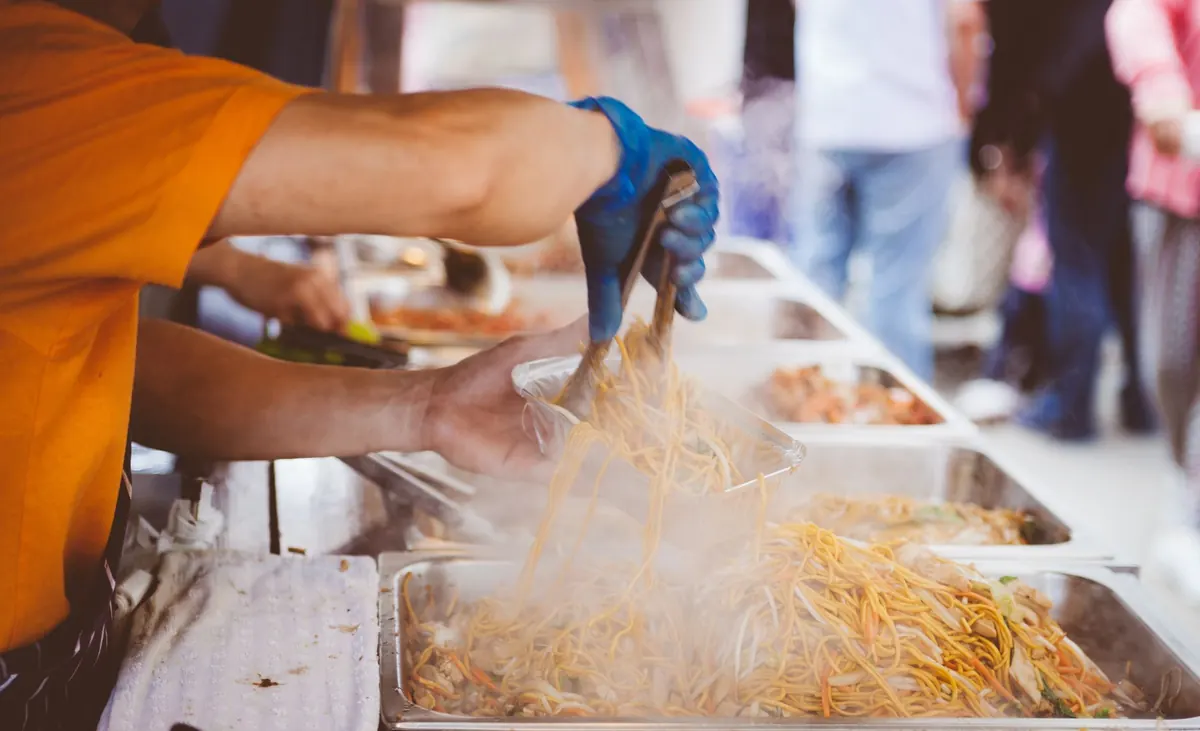
- Hot food counters: roast pork, poached chicken and stir-fried noodles, usually sold by weight.
Bring a cool bag or an insulated box, particularly from spring through autumn. Mesa heat will undo an hour of shopping in a car park in ten minutes. Ask at the seafood counter to have fish cleaned and scaled for you — it is normal, and nobody will make a fuss.
A half-day plan that works
- Arrive mid-morning, before the lunch rush has built.
- Walk one supermarket end to end, without buying anything yet. You will spot things you want to eat later.
- Pick up something from the bakery to take home.
- Eat lunch in a food court, sharing two or three dishes between two people rather than ordering a main each.
- Do your proper shop afterwards, once you know what you liked.
- Finish with an iced coffee or a bubble tea.
- If you have room, come back in the evening for Korean barbecue.
Practical notes before you go
Check opening hours before you commit to a special trip. Some restaurants and smaller shops close on one weekday, and a few shut between lunch and dinner. Weekends, especially Sunday lunchtime, are the busiest; arriving before noon or after half past one makes a real difference to whether you queue.
Menus are not always in English, and that is not a problem. Look at what other tables are eating, point, or simply ask — staff are used to helping
Photo: Clem Onojeghuo / Pexels